

December 23, 2025
2 min read

Key takeaways:
- Home exercise with or without physical therapy for degenerative meniscal tears had similar KOOS pain scores at 3 months.
- The physical therapy groups continued to have better levels of improvement after 3 months.
Published results showed a combination of home exercise and physical therapy did not result in greater pain reduction compared with home exercise alone in patients with degenerative meniscal tear and knee pain.
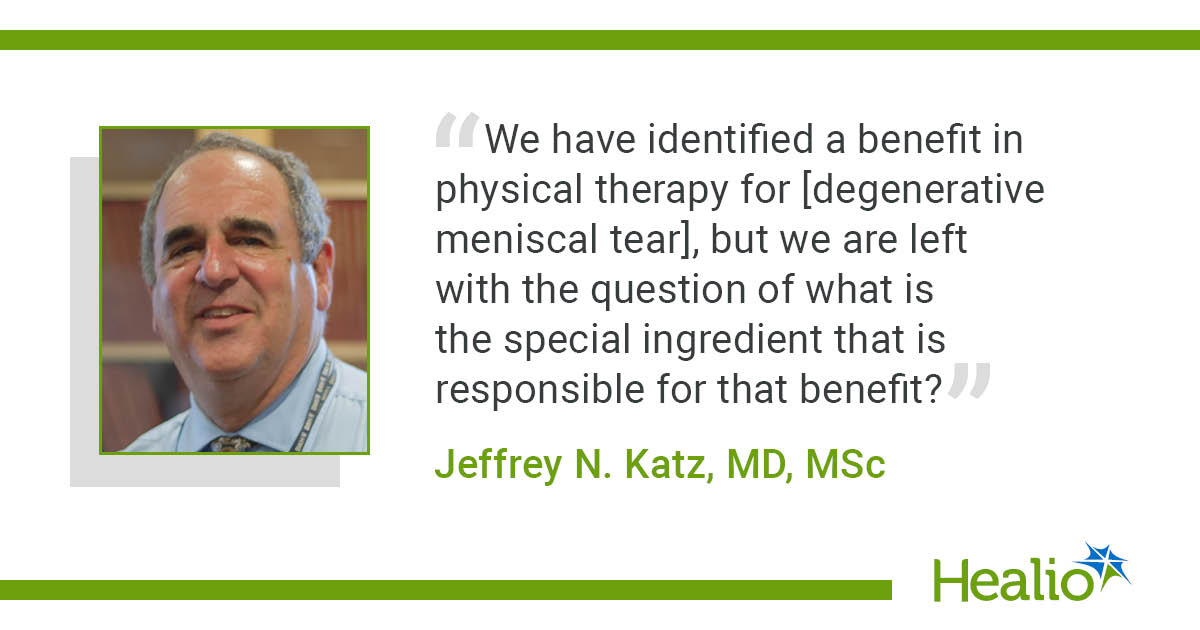
“We have identified a real benefit in seeing a physical therapist for people with [degenerative meniscal tear], but we are left with the question of what is the special ingredient that is responsible for that benefit? It doesn’t appear that the exercises are that special ingredient,” Jeffrey N. Katz, MD, MSc, professor of medicine and orthopedic surgery at Brigham and Women’s Hospital and Harvard Medical School, told Healio.

Katz and colleagues randomly assigned 879 patients aged 45 to 85 years with knee pain, osteoarthritis and meniscal tear to a 3-month home-exercise program, a home exercise program plus text messages to encourage exercise adherence, a home exercise program plus text messages plus sham physical therapy, or a home exercise program plus text messages plus standard physical therapy. Researchers considered change in KOOS pain subscore between baseline and 3 months as the primary outcome measure.
At 3 months, Katz said all four groups had similar levels of improvement. Although the two groups that underwent physical therapy had better levels of improvement at 6 and 12 months, he said “whether the physical therapist administered standard physical therapy or sham physical therapy did not matter.”
“Those two groups’ outcomes were virtually identical,” Katz said. “We concluded that there is a measurable benefit to seeing a physical therapist that plays out over a period of the first year, but that benefit does not appear to arise from the exercises that were administered.”
Katz said these results raise the question of whether there is a subset of patients who will have good outcomes without seeing a physical therapist, and future analysis of their research will aim to identify these aspects.
“What were the things that identified those who were most likely to benefit from seeing a physical therapist vs. those who didn’t get any additional benefit? That will be useful for the orthopedic and musculoskeletal community,” Katz said. “These patients are seen in orthopedics, but they’re seen in primary care and in the rheumatology and rehabilitation populations. It will be important in these provider communities to try to get an understanding of who is most likely to benefit from receiving physical therapy.”
For more information:
Jeffrey N. Katz, MD, MSc, wishes to be contacted through Timothy F. Sullivan at tsullivan11@mgb.org.
Perspective

Jeffrey N. Katz, MD, and colleagues provide an interesting research article examining the effectiveness of various combinations of home rehabilitation programs, text message encouragement, sham in-person physical therapy and in-person clinically performed physical therapy.
The rehabilitation of individuals with meniscus tears in the age range of 45 to 85 years represents an interesting and very challenging patient population. Patients with meniscus tears in this age group often exhibit degenerative type tears with associated articular cartilage pathology. Although subjects with grade IV articular cartilage lesions were excluded, lower grades of articular cartilage damage (grades III to I) can represent a reasonable source of pain due to associated synovial membrane and capsular inflammation.
Several factors combine to make these patients a challenge to successfully treat, including:
- patient’s BMI;
- patient’s lower extremity alignment;
- degree of associated articular cartilage wear;
- patient’s desired activity level, type of work and/or recreational activities (sport); and
- extent of meniscus loss.
There are several points/questions to consider before drawing final conclusions from this study. The authors stated that only 100 minutes of exercise was performed per week in four 25-minute bouts, which we find to be totally under dosed. In addition, the authors state they prescribed stretching and strengthening exercises. We need more specifics such as, what type of exercises and in what specific amounts. Quad sets and straight leg raises are strengthening exercises, but our experience would indicate that these patients are optimally managed with an individualized designed program based on their specific level of discomfort during exercise. These patients often benefit from stationary bicycling; quadriceps, hamstring and calf stretches; hip abduction strengthening; and quadriceps strengthening in a functional manner, in tandem with proprioception drills. These types of patients often benefit from patient education, such as proper shoe recommendations, walking for exercise, biking, pool exercises and possibly an unloading brace.
Patients with a meniscus tear in this age range require an individualized rehabilitation program with modifications based on periodic assessments to ensure optimal long-term outcomes.
Kevin E. Wilk, DPT, FAPTA
Christopher Arrigo, PT, DPT, ATC
Disclosures: Arrigo and Wilk report no relevant financial disclosures.

Ask a clinical question and tap into Healio AI’s knowledge base.
- PubMed, enrolling/recruiting trials, guidelines
- Clinical Guidance, Healio CME, FDA news
- Healio’s exclusive daily news coverage of clinical data
#Similar #knee #pain #relief #physical #therapy







Leave a Reply