

December 23, 2025
2 min read
Key takeaways:
- Individuals who used GLP-1s before or early in pregnancy had a higher risk for gestational weight gain.
- A researcher said more efforts are needed to identify optimal discontinuation timing before pregnancy.
Discontinuation of GLP-1 receptor agonists before pregnancy or early during pregnancy was tied to more gestational weight and a higher risk for some adverse health outcomes, a study in JAMA Women’s Health showed.
The data “suggest that people on GLP-1s discontinuing the medication for pregnancy require closer monitoring for excess weight gain and complications,” Jacqueline Maya, MD, a pediatric endocrinologist at Massachusetts General Hospital, told Healio. “More research is needed to determine the best approach to monitoring and managing these patients once the medication is discontinued.”

Data derived from: Maya J, et al. JAMA. 2025;doi:10.1001/jama.2025.20951.
According to Maya and colleagues, current evidence on links between GLP-1s and pregnancy complications “remain limited, conflicting and subject to residual confounding by indication or selection and recall bias.”
They added that if gestational weight gain is a result of GLP-1 discontinuation before or early during pregnancy, “negative outcomes for the parent-child dyad could result.”
In the retrospective analysis, the researchers assessed outcomes among 149,790 singleton pregnancies delivered between June 1, 2016, and March 31, 2025.
For the primary study outcome — gestational weight gain — 488 GLP-1-exposed pregnancies (people receiving at least one GLP-1 medication between 3 years before and 90 days after pregnancy) were propensity-score matched with 1,344 unexposed pregnancies.
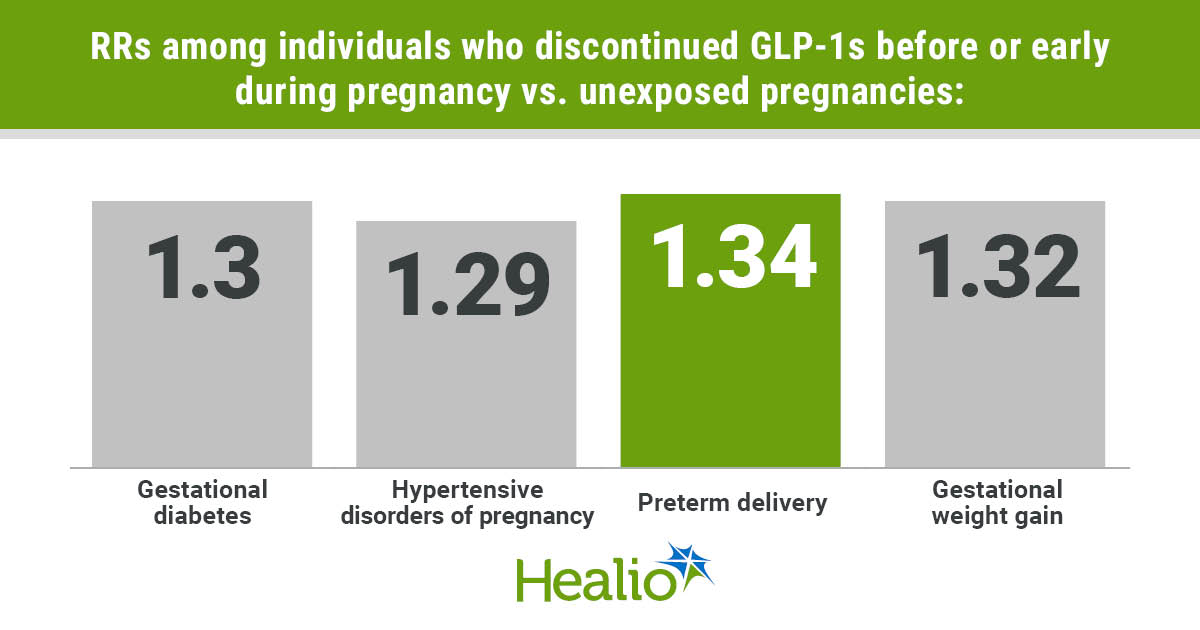
Maya and colleagues reported that pregnancies exposed to GLP-1s had a greater risk for gestational weight gain (RR = 1.32; 95% CI, 1.19-1.47) vs. unexposed pregnancies.
GLP-1-exposed pregnancies were also at a higher risk for:
- gestational diabetes (RR = 1.3; 95% CI, 1.01-1.68);
- hypertensive disorders of pregnancy (RR = 1.29; 95% CI, 1.12-1.49); and
- preterm delivery (RR = 1.34; 95% CI, 1.06-1.69).
“Despite a small detectable increase in birth weight of newborns from GLP-1-exposed pregnancies, there was no increased risk of large or small for gestational age birth weight or cesarean delivery associated with pre-pregnancy or early pregnancy GLP-1 use,” Maya and colleagues wrote.
The researchers suggested the benefits of GLP-1s before pregnancy “could be negated or attenuated by the adverse effects of GLP-1 discontinuation.”
They added the higher risk for gestational weight gain may contribute to the increased risk for hypertensive disorders of pregnancy and gestational diabetes “given the established relationship between gestational weight gain and adverse pregnancy outcomes.”
Maya told Healio that many individuals are on GLP-1s before pregnancy “and are benefiting tremendously.”
“Clinicians following these patients need to know that when their patients stop these medications for pregnancy, they are at risk for greater gestational weight gain and greater risk for gestational diabetes, hypertensive disorders of pregnancy and preterm delivery,” she said.
Future research should identify strategies “to mitigate pregnancy-related weight gain in people who stop GLP-1s for pregnancy,” Maya said.
“As more people are exposed to the medication, we should conduct studies that allow us to determine the best timing for discontinuation prior to pregnancy,” she added. “Additionally, while our findings are reassuring with regard to effects on newborn birthweight, we will need to exclude any potential long-term impact on childhood metabolic health.”
For more information:
Jacqueline Maya, MD, can be reached at primarycare@healio.com.

Ask a clinical question and tap into Healio AI’s knowledge base.
- PubMed, enrolling/recruiting trials, guidelines
- Clinical Guidance, Healio CME, FDA news
- Healio’s exclusive daily news coverage of clinical data
#Discontinuing #GLP1s #early #pregnancy #raises #risk #complications




Leave a Reply